GRETEL Payload on our CubeSat
by 🧑🚀 Mika Schultes on Wed Apr 08 2026
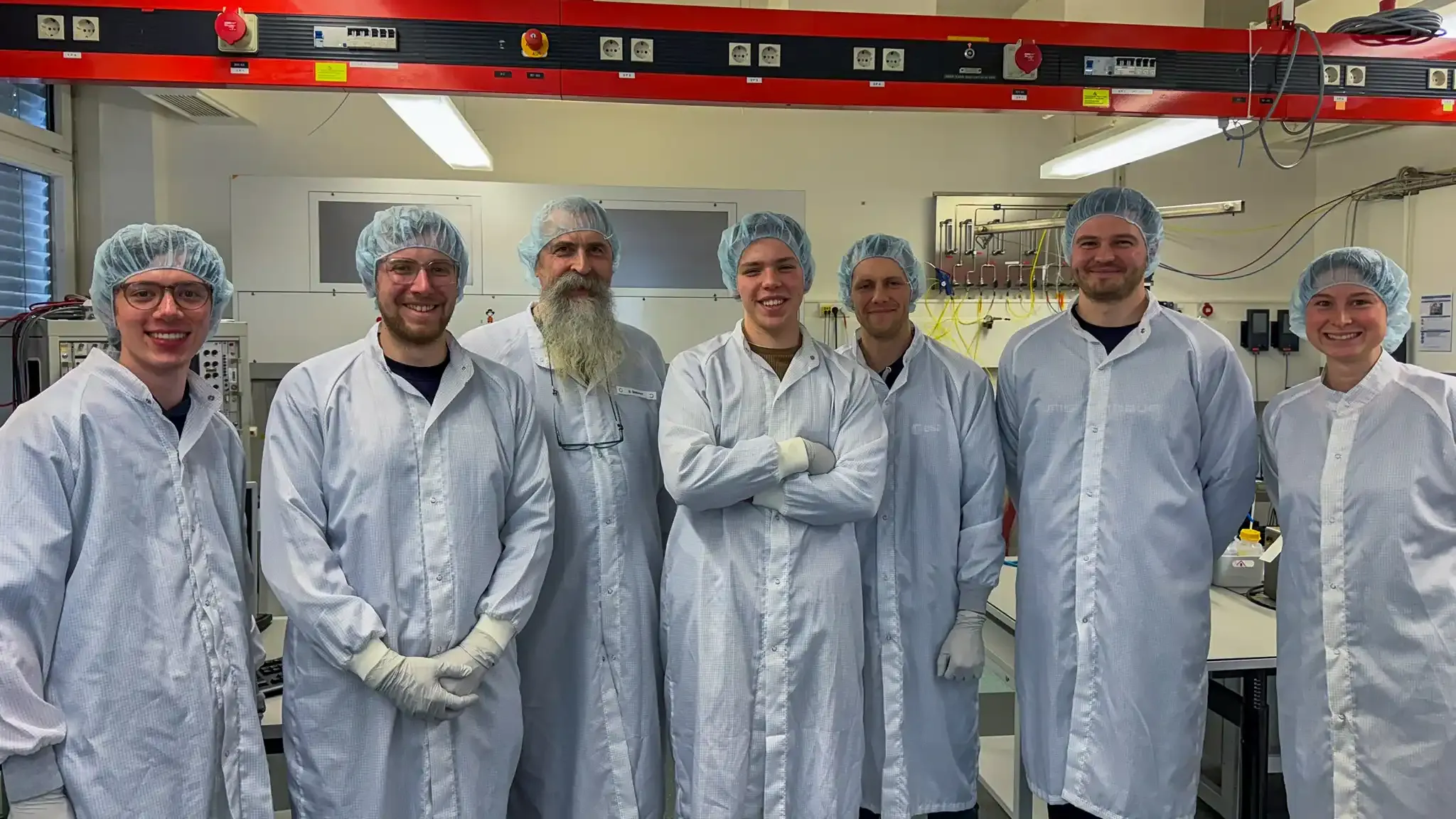
What does the NASA Curiosity Rover, ESA Solar Orbiter and hamburgs first satellite have in common? Particle Detection Units from CAU Kiel!
Last week, our team visited the Department for Extraterrestrial Physics at the Institute for Experimental and Applied Physics at Christian-Albrechts-Universität zu Kiel.
The visit marks an important step in our ongoing CubeSat mission, as we are collaborating with the CAU team on the integration of a heavy particle detector. The instrument, named GRETEL, is based on a BGO (bismuth germanate) scintillation crystal and is designed to detect high-energy particles in space.
GRETEL will complement our in-house HANS payload, expanding the scientific capabilities of the mission and enabling more comprehensive measurements of the space radiation environment.
What makes this collaboration particularly exciting is CAU’s extensive heritage in particle detector development. Their instruments have been successfully deployed across a wide range of missions. From atmospheric research on BEXUS campaigns to deep-space applications. Notable missions include the lunar surface via Chang’e 4, ESA’s Solar Orbiter, and planetary exploration with the Curiosity rover on Mars.
By combining this proven flight heritage with the agile, student-driven “New Space” approach of Hamburg Space Team, we aim to create a mission that is both technically robust and highly innovative.
We are looking forward to the coming months of development, testing and ultimately, to launching our CubeSat and bringing this collaboration into orbit.
Tagged: HANS